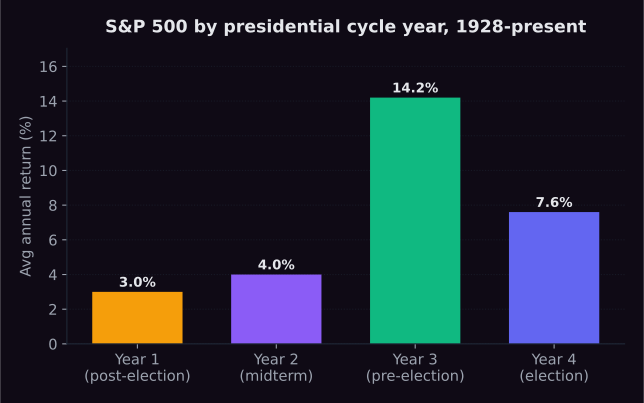
“Buy the third year.” It is one of the oldest rules of thumb on Wall Street, and the chart behind it looks too clean to ignore. Plot the average S&P 500 calendar-year return by the four positions of the U.S. presidential cycle and year three leaps off the page. Hirsch’s Stock Trader’s Almanac, the source most retail commentary traces back to, puts the year-three average near 14%, with the other three years bunched between roughly 3% and 8%. The pattern is real in the historical record. What it means, and what you can actually do with it, is where careful investors and folklore part ways.
The term-cycle pattern has a plausible mechanism, a measurable footprint in equity data back to 1928, and a body of academic research that takes it seriously enough to argue about. It also has one feature that should keep any honest analyst awake at night: a sample of roughly 24 four-year cycles. That is enough to report an average. It is not enough to trust that the average will hold next time, especially once you correct for how many calendar patterns get tested.
The pattern, in numbers
The Hirsch numbers, cross-checked against Beyer, Jensen and Johnson (2008), are easy to summarize. Across U.S. presidential cycles since 1928, average S&P 500 calendar-year returns by year-of-term run roughly:
- Year 1 (post-election): around 3%
- Year 2 (midterm): around 4%
- Year 3 (pre-election): around 14%
- Year 4 (election year): around 7-8%
Year three has been the standout for most of the post-war period. The pattern is robust enough to appear in raw averages whether you start the sample in 1928, 1945, or 1952, and whether you use the Dow or the S&P 500 as your benchmark. It is also the part of the cycle where the variance is highest. The asymmetry matters: as we will see, the year-three average is a blend of spectacular gains and brutal losses, not a smooth ride.
The mechanism story
The standard narrative for why year three outperforms is a political-economic one. New administrations, the argument goes, push their most painful or controversial policies in the first year or two, when they have political capital to spend and three or more years before the next election to absorb the fallout. By year three, with a re-election or successor campaign looming, incumbents lean toward voter-friendly stimulus: tax adjustments, accommodative spending, regulatory easing, and rhetorical pressure on the central bank to keep monetary policy supportive. Markets, the story continues, anticipate and reward this turn.
Beyer, Jensen and Johnson (2008), in The Presidential Term: Is the Third Year the Charm?, look for empirical fingerprints of this mechanism. They find that Federal Reserve policy has historically tended to be looser in years three and four than in years one and two, and that the equity outperformance is more pronounced in small-cap stocks than in large-cap, consistent with a stimulus-driven liquidity story. The mechanism is not proven, but it is at least consistent with the data rather than ad hoc.
There is a parallel literature on the partisan question. Santa-Clara and Valkanov (2003), in The Presidential Puzzle, document a much larger gap between returns under Democratic and Republican presidents (roughly 9 to 16 percentage points per year, depending on weighting, 1927-1998). Powell, Shi, Smith and Whaley (2007) push back on the statistical inference, arguing that partisan dummies are highly persistent regressors and standard t-statistics overstate significance. Pastor and Veronesi (2017) build a rational equilibrium model in which higher returns under Democrats arise endogenously from time-varying risk aversion. The partisan question is fascinating but mostly orthogonal to the year-of-term question this article is about.
Why a 14% average is not what it looks like
Here is where the folklore tends to break down. With about 24 modern four-year cycles in the sample, year three is represented by roughly 24 observations. That is a small enough sample that one or two outlier years dominate the mean.
Consider what happens when you walk through the year-three list. Year three has produced some of the best calendar-year S&P 500 returns of the modern era: 1995 (around 34% on a price basis), 1999 (around 20%), 2009 (around 23% off the financial-crisis lows), 2019 (around 29%), and 2023 (around 24%). Stack those together and the average is going to look spectacular regardless of what happens elsewhere.
It has also produced some of the most painful drawdowns. 2007 was a year three, and the S&P 500 was roughly flat that calendar year before falling apart in 2008. 1987, the year of the October crash, was the third year of the Reagan-Bush term ahead of the 1988 election. Take those out and the average rises further. Leave them in and the average is the figure investors quote. Drop them and replace them with another financial-crisis-style year, and the average could easily be cut in half.
This is the small-sample problem in microcosm. The 14% figure is not wrong, in the sense that it is the actual arithmetic mean of the recorded year-three returns. It is misleading in the sense that the standard error around that mean is wide enough that you should not plan a portfolio around it.
Powell, Shi, Smith and Whaley (2007), best known in this literature for the partisan-dummy critique, make a related methodological point that applies here too: in markets where regressors of interest persist for years at a time (and a presidential term is roughly the canonical example), classical inference understates uncertainty. The same caution applies to the term-of-cycle pattern.
Beyer, Jensen and Johnson (2008) examined whether the third-year result was robust to outliers, partly in response to the kind of sample-size objection Powell et al. raised. Their reading is that the pattern survives reasonable robustness checks, but they are explicit that each presidential term yields only one observation per year-position, so all conclusions are drawn from a few dozen data points. That is honest scholarship and a more measured claim than the almanac headline.
The international evidence
The presidential-cycle pattern is, by definition, U.S.-specific. But other countries with regular election cycles have been studied too. Wong and McAleer (2009) examine election-cycle effects in four South Asian markets (Hong Kong, Malaysia, Singapore and Taiwan) and find some evidence of cycle-related patterns, though the magnitudes and directions vary. The international evidence is fragmented and does not give the U.S. third-year story the kind of out-of-sample confirmation that the Halloween effect gets from Bouman and Jacobsen’s 36-of-37-country sweep.
This matters for how you think about the result. The Halloween effect is a Bouman-and-Jacobsen-grade anomaly: a documented regularity that holds across dozens of independent country samples, with an out-of-sample replication (Andrade, Chhaochharia and Fuerst 2013) using post-publication data. The presidential-cycle pattern is not in that league. It is, more honestly, a folk pattern with a plausible mechanism and weak statistical power. A reasonable reader can either treat it as a real but small effect or as data-mined noise; both positions are defensible given current evidence.
What history actually says about year three
If you set aside the average and look at year three case by case, you get a more useful picture for thinking about position-sizing. Of the post-war year-three cases, the modal outcome is a positive year, often a strongly positive one. Negative years happen, and when they do they tend to be tied to identifiable macro shocks rather than to the cycle itself: the 1987 crash, the 2007 prelude to the credit crisis. Those are exactly the kind of low-probability, high-impact events that no calendar pattern can anticipate.
The midterm-low-to-pre-election-high “sweet spot” trade is another version of the same observation. The traditional formulation is that equities tend to be weak through the second year of a term and strong from the second-year low into the third year. The pattern shows up in averages, but the second-year low is identified ex post, and getting the timing right requires more than the calendar.
The data-mining caveat
Calendar-based anomalies are particularly vulnerable to data-mining critiques. The Stock Trader’s Almanac contains dozens of patterns: the Santa Claus rally, the January barometer, the pre-holiday effect, the first-five-days indicator, the Mark Twain effect, and on and on. If you publish twenty independent calendar patterns and apply standard 5% significance thresholds, you should expect roughly one to look statistically significant by chance even if none of them is real. Sullivan, Timmermann and White (2001), in their bootstrap analysis of calendar effects in the Journal of Finance, formalize this concern: after multiple-testing correction, many calendar regularities lose statistical significance.
The presidential cycle has the partial advantage of a plausible mechanism, which raises the prior that it reflects something real. It also has the disadvantage that the mechanism is qualitative (“incumbents stimulate”) rather than quantitatively pinned down, so it is hard to test the mechanism independently of the pattern it is invoked to explain.
Practical takeaway
Treat the presidential cycle as one input among several, not as a standalone trading rule. The pattern is real in the historical record and has a coherent if unverified political-economic mechanism. The statistical power is weak. The variance within year three is large enough that an average return of 14% can include double-digit gains and double-digit losses in roughly the same decade.
If you find the pattern intriguing, the right way to use it is as a regime overlay rather than a position. A rough rule of thumb: in year three, lean toward higher equity exposure than your baseline if other indicators (valuation, momentum, monetary policy) agree, and consider trimming if they disagree. Do not lever up purely on the calendar. The 1987 and 2007 cases are not anomalies to be explained away, they are evidence about how much you should be willing to bet on a pattern with 24 data points.
The midterm-low-to-pre-election-high sweet spot is more interesting as a research question than as a strategy. The historical pattern exists. The execution problem is identifying the midterm low in real time, which the calendar alone does not solve. Combine with confirming indicators (breadth, credit spreads, sentiment), and the trade becomes more disciplined than calendar-driven. Use the cycle as a hypothesis to test, not as a directive to obey.
References
- Hirsch, Y. and Hirsch, J. (annual editions). Stock Trader’s Almanac. Wiley.
- Beyer, S., Jensen, G. R. and Johnson, R. R. (2008). The Presidential Term: Is the Third Year the Charm? Journal of Portfolio Management.
- Powell, J. G., Shi, J., Smith, T. and Whaley, R. E. (2007). The Persistent Presidential Dummy. Journal of Portfolio Management 33(2).
- Santa-Clara, P. and Valkanov, R. (2003). The Presidential Puzzle: Political Cycles and the Stock Market. Journal of Finance 58(5), 1841-1872.
- Pastor, L. and Veronesi, P. (2017). Political Cycles and Stock Returns. NBER Working Paper 23184.
- Wong, W.-K. and McAleer, M. (2009). Mapping the Presidential Election Cycle in U.S. Stock Markets. Mathematics and Computers in Simulation. (Companion work covers South Asian markets.)
- Sullivan, R., Timmermann, A. and White, H. (2001). Dangers of Data Mining: The Case of Calendar Effects in Stock Returns. Journal of Finance 56(5).